
Alternative Metamorphosis: Going Retail

I logged into my account at Vanguard Investments last week to find the following ‘banner ad’ across the top of my home screen. My mind raced as I contemplated what led Vanguard to make this rather bold promotion.

The convergence between traditional and alternative investments is no secret, but the last place I ever expected to see private equity being advertised would be Vanguard Investments. Vanguard founder John “Jack” Bogle built his firm by pioneering low-cost, highly liquid, index investing. His firm ignited the most powerful investment trend of the last twenty years, the shift from actively managed mutual funds to passively managed Exchange Traded Funds (ETFs). Along the way Vanguard became an asset management juggernaut with over $11 trillion in assets under management, the 2nd largest in the country. I wondered what the late Jack Bogle would think if he saw this banner ad! Was he spinning in his grave right now?
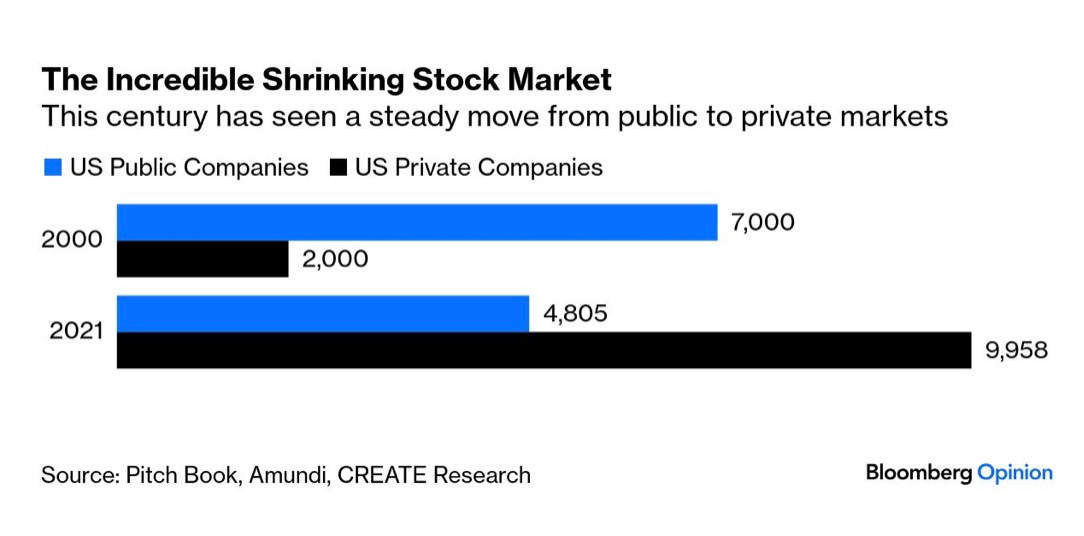
Public to Private Market Sea Change Underway. The shift from active mutual fund investing to passive/index investing defined the last twenty years in the asset management industry. Will the shift from traditional public market investing to alternative private market investing define the next? It certainly looks likely. Why? With the number of publicly traded companies shrinking fast and public stock indexes increasingly dominated by giant “mega-cap” technology companies, many have called to “democratize” access to private market investments such as private equity, private credit and venture capital in the name of diversification. Indeed, 85% of all large companies today are now in private hands according to Goldman Sachs, a remarkable statistic. (See Figure below from Bloomberg) More importantly, a recent survey by CAIS suggests that almost 50% of retail investors are now interested in alternatives and 25% are actively considering them!
Asset Managers Venture Forth Together. It appears that neither asset managers nor investors are waiting around for any legal or regulatory change before positioning themselves to ‘go retail.’ They know that almost 50% of global wealth is held by individual investors. Even a small share of this wealth means huge inflows. Traditional and alternative asset managers eager to be first movers have begun teaming up to develop and launch investment products that blend private investments into a variety of investment vehicles for retail investors, including “target date funds” that are used in 401(k) retirement accounts and so-called “Evergreen” funds that offer private market investments in “semi-liquid” accounts with lower minimums.
In fact, in 2024 there were a record number of strategic acquisitions between traditional and alternative asset managers (63 deals per Bain & Company), the largest of which was Blackrock (the world’s largest traditional asset manager) buying HPS (a large private credit firm). Further, numerous partnerships between traditional and alternative managers were forged last year, including between Apollo Inc. (a large alt manager) and State Street Investment Management (a large ETF provider), between KKR ( a large alt manager) and Capital Group (a large retirement manager), and a three-way venture between Blackstone (the world’s largest alt manager), Wellington (an active asset manager) and Vanguard Investments! Notably, most of these joint ventures involve large players in the massive ($12.5 trillion) 401(k) market. Vanguard Investments controls 40% of the market for “target-date” retirement funds, most often cited as the preferred vehicle for delivering private investments into retirement accounts.
The Horizon Looks “Evergreen.” Starting around 2020, alternative managers introduced innovative “semi-liquid” fund structures that allow non-accredited investors into private markets. These registered funds mostly offer investments in private credit and real estate assets, but most all these funds have lower investment minimums, periodic redemption opportunities (subject to limits), incentive/management fee structures, and simplified tax reporting. These funds have sold like hot cakes through the registered investment advisor (RIA) and financial advisor communities in the name of diversification, which is a powerful theme in today’s tech-dominated public markets. Assets under management in these registered funds topped $500 billion in 2025 and growth shows no sign of slowing with almost 100 new funds introduced in 2025, including some private equity funds. We will discuss these unique funds in more detail in future columns, but no doubt they are here to stay.
Visibility Might Be Limited on this Voyage into Private Markets. It will be interesting to see whether the “democratization” of private markets will be accompanied by “democratized” disclosure rules or investor protections. Retail investors are very familiar with investments that are highly liquid (can be sold at least daily), have transparent and objective valuations (using market-based inputs), and a clear fee structure (e.g. a 0.10% management fee for a Vanguard Index fund).
Private market investments operate entirely differently, mainly because they have only been open to sophisticated institutional or high net worth investors. As discussed in previous columns, private investments are long-dated investments in whole companies (LBO investing), whole loans to companies (private credit), equity stakes in real estate, and minority stakes in start-ups (venture capital) that only become liquid once these investments mature and are exited. Successful private market investing takes years, and in the interim private investors rely on subjective internal models to track value. Fee structures, discussed in our recent column here ( fee column) are complex, burdensome, and dynamic based on performance.
The Shifting Regulatory Landscape. In August 2025, President Trump signed an executive order proclaiming that “Americans should have access to retirement funds that include investments in alternative assets,” and directed the Department of Labor to revise rules to encourage retirement accounts such as 401(k)s to include private investments. These new rules are expected to be revealed in the next few months. In December 2025, the US House of Representatives passed the Incentivizing new Ventures and Economic Strength Through Capital Formation Act (INVEST). This law encourages updating securities laws to allow investors better access to private markets. The Senate has yet to take up this law, however. Beyond this, the share of US households already qualifying as “accredited investors” (and thus able to participate in alternative investments) rose to 22% in 2022 and is on track to hit 30% by 2030 (per JP Morgan).
Regulatory change will likely augment the convergence of public and private markets with improved accessibility for retail investors. In fact, Bain & Co. estimates that 25% of all asset growth for global alternatives will come from individual private wealth (retail investors with $1-30mm in assets) over the next ten years. And given the size and power of mass market investing, it could entirely change the industry’s priorities.
I never did learn what potential private equity investment Vanguard wanted me to consider, but something tells me I will see a similar banner ad again very soon!
I feel something good will come out of Vanguard and Capital Group joining this private markets space even though they might have entered it for not so good reasons like the potential to make more fees. It’s a matter of time before their legal teams would be breathing down the necks of their alt asset managers to increase their disclosures and stop shady valuation practices. For now, these are grand schemes to dump non-performing assets to retail investors in the name of diversification and democratization.