
Private Equity Check-In: Please Clear the Exits!

Despite AI-related angst roiling equity markets the last month, major indexes remain close to their all-time highs. Private equity fund managers (aka general partners/GP’s) continue to have high hopes for 2026 after a huge year for investments (buying portfolio companies) and an improved year for “exits” (selling or IPO’ing companies) in 2025. Whether markets remain healthy enough to support more robust investment activity and continued progress in deal exit activity is an open question, particularly given newfound investor unease with the software industry, which represents a sizable piece of private equity portfolios.
Bain & Co. issued its annual private equity outlook for 2026 over the weekend, providing an excellent lay of the land for the PE industry today (linked here). Bain’s report is a powerful reminder of the size and importance of private equity today. Buyout funds have raised a remarkable $1.8 trillion in capital since 2022 and still have $1.3 trillion of “dry powder,” or committed capital waiting to be invested! Beyond this, companies under PE ownership now account for about 7% of US GDP!
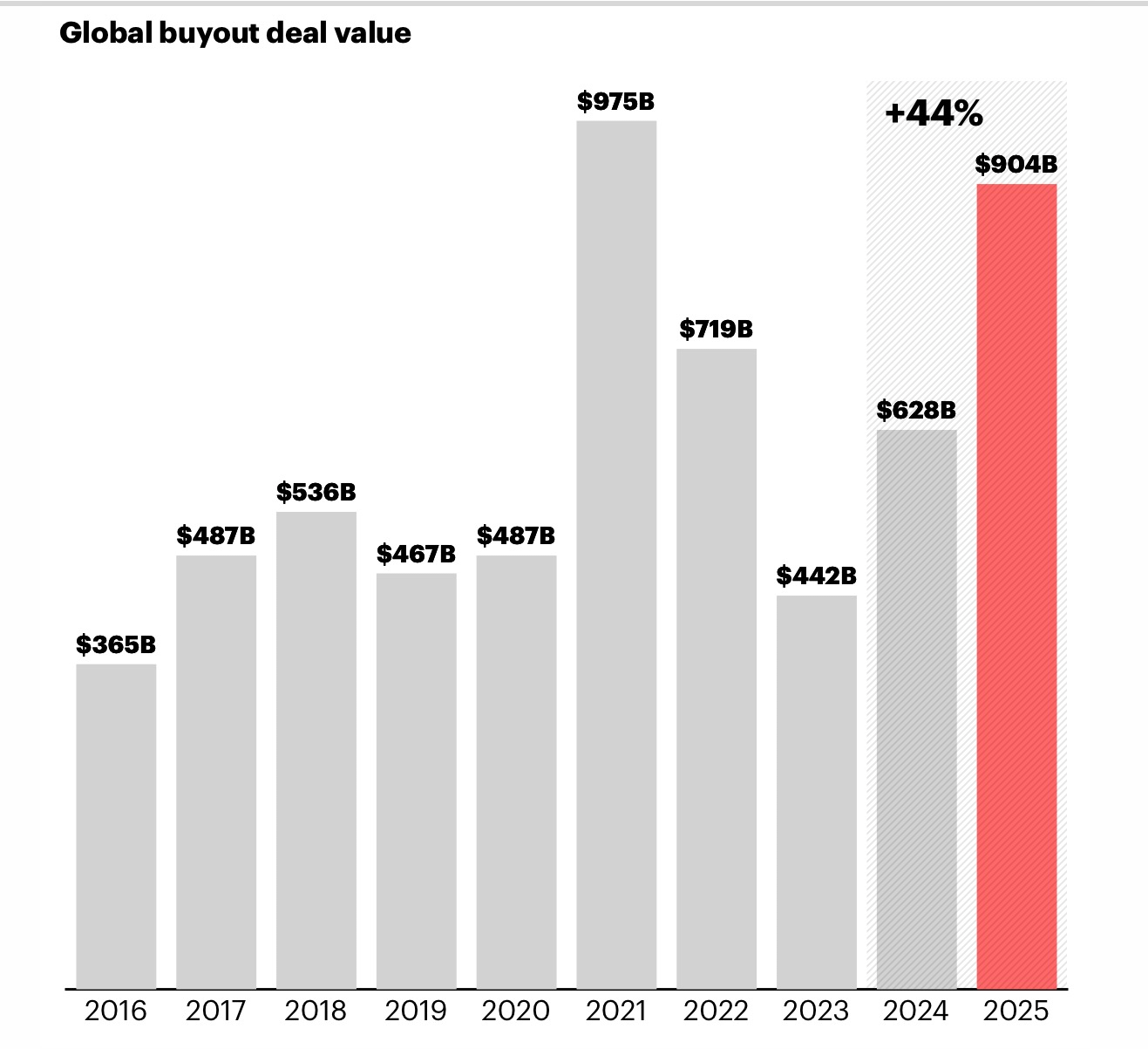
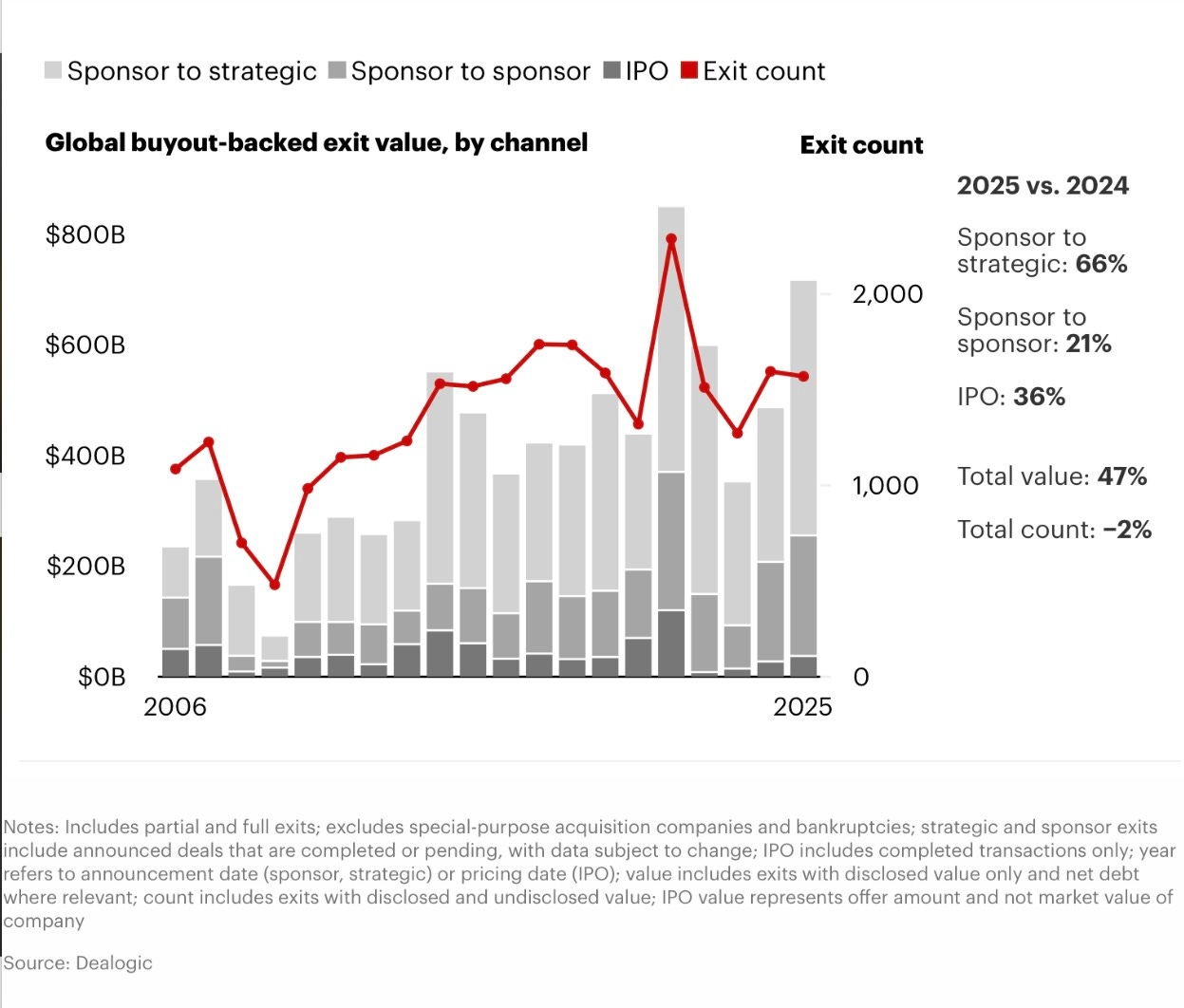
Deal activity (PE firms buying portfolio companies) jumped to $904 billion in 2025, up 44% from 2024 levels driven by several enormous leveraged buyouts, including the megadeal for gaming company Electronic Arts. All-important “exit” activity (PE firms selling or IPO’ing portfolio companies) rose 47% from very low levels to $717 billion in 2025. See figures below.
Source: Bain & Co. Dealogic
Source: Bain & Co. Dealogic
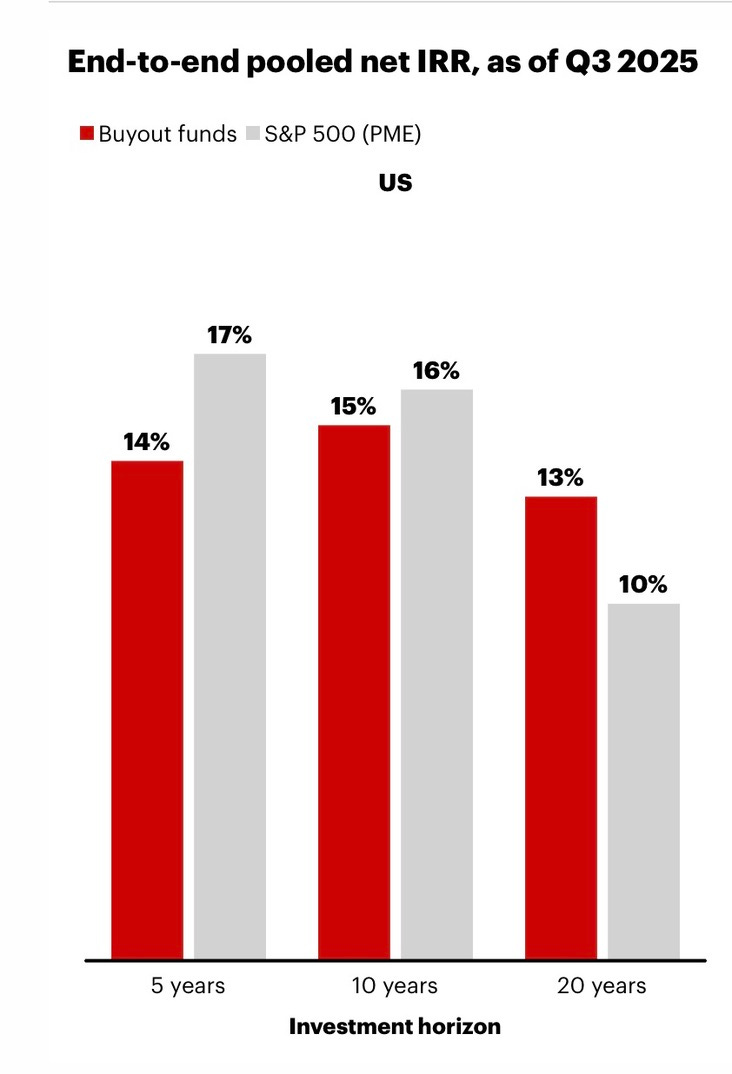
PE Industry Outlook Measured. For a global PE firm, Bain’s 2026 outlook report struck a surprisingly cautious tone. Why? Firstly, private equity returns trailed public stock markets for the third year in a row in 2025 (as measured by internal rate of return or IRR). US buyout funds now lag public stock markets over five- and ten-year time horizons (see Bain’s figure below). Notably, PE still bests public market benchmarks over a 20yr time horizon, arguing long term investors in the asset class have been rewarded.
Source: Bain & Co. MSCI.
Weaker returns in recent years stem from a few factors. First, interest rates are higher today vs. when most portfolio companies were bought (on average five years ago), which is hampering company valuations. Second, both acquisition and IPO activity have been muted the last few years, which is limiting exit options and values for portfolio companies. Money flows tend to follow performance in the investment business and so private equity fundraising is slowing. Fundraising dollars fell 16% to just under $400 billion in 2025.
Exit Congestion The other issue facing the PE industry today is the vast unsold inventory of portfolio companies that need to be “exited” (i.e. sold or IPO’d). As discussed in our first Substack on private equity (linked here), PE firms utilize closed-end funds with finite lives, usually ten years, to execute their strategy of buying companies with leverage and improving their value by raising profitability. As investments mature and portfolio companies increase in value, GP’s move to “exit” these investments and generate distributions, i.e. realized gains/cash payments back to fund investors (known as limited partners or LP’s).
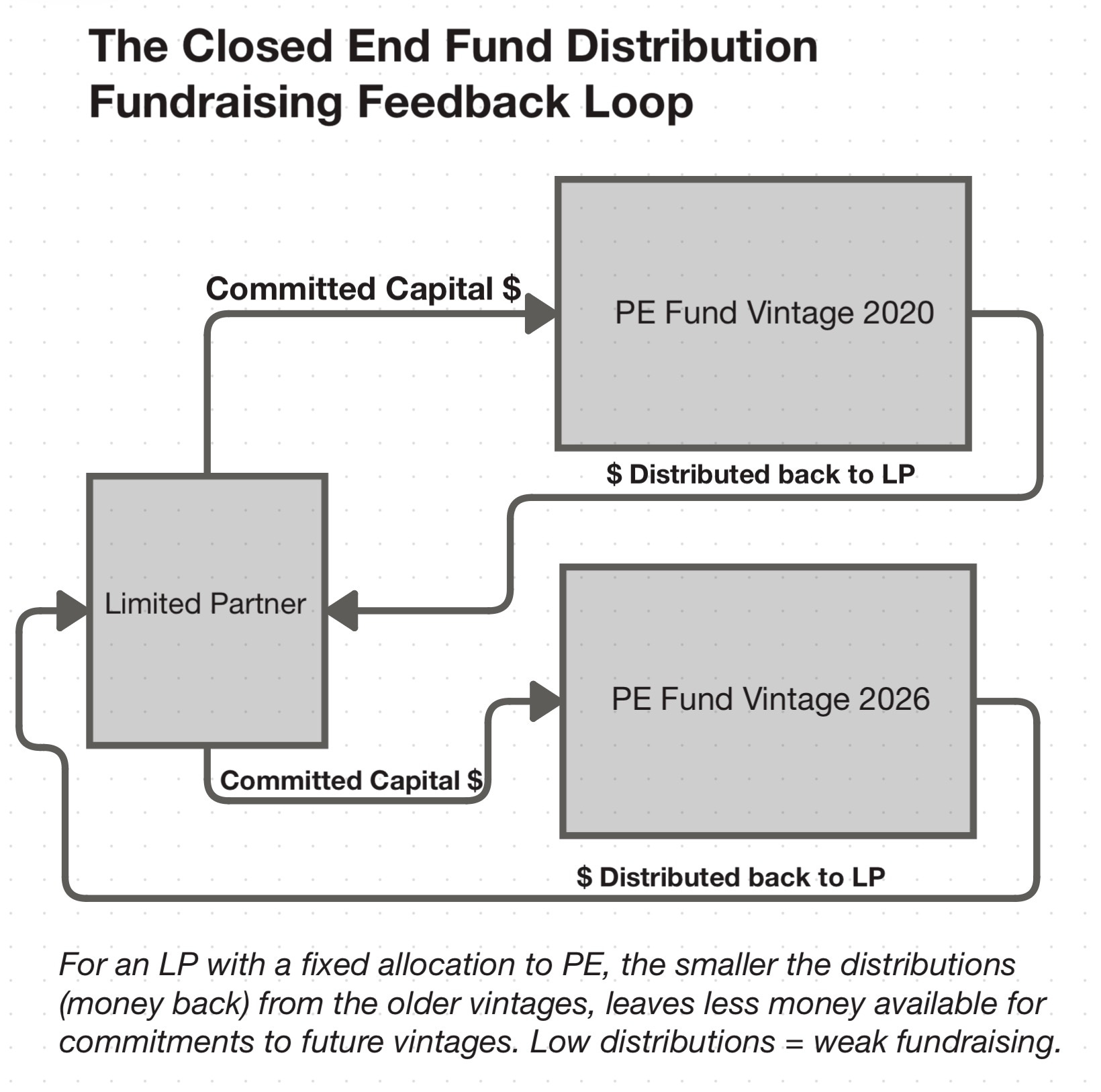
Lower Distributions = Lower Fundraising Currently there are 19,000 unsold portfolio companies worth a remarkable $3.8 trillion sitting in private equity closed-end funds. Even with IPO and acquisition markets looking up, Bain & Co. believes that activity remains well below levels necessary to support a timely exit of this backlog before funds reach the end of their lives, which could further pressure GP’s. Distributions as a percentage of net asset value have been less than 14% now for four years, well below industry averages. This dynamic further depresses fundraising as many fund investors/LPs rely on cash distributions from existing funds to invest in new PE fund offerings. This distribution/fundraising dynamic is illustrated in my diagram below. If an existing PE investment (e.g. Vintage 2020) is returning half as much cash each year as anticipated, there is half as much cash to reinvest in the new fund that is fundraising (e.g. Vintage 2026).
PE firms have the capacity to rise to the challenge posed by clogged exit markets, and they are certainly motivated to do so given the knock-on effects on fundraising. Indeed, many GPs are pursuing alternative methods to return capital such as continuation funds, dividend recapitalizations and selling portfolio companies to other sponsors (which we will explain in future columns). Time will tell if GP’s will get a bigger assist from acquisition activity and IPO markets in 2026.
This is not investment advice.