
Shipping as an Alternative
Exploring a Different Alt Investing Strategy

For most investors the conflict with Iran has created unwelcome market volatility. Even hedge funds, which tend to thrive when markets come unglued, were reportedly caught flat-footed by extreme commodity market turmoil.
The Middle Eastern conflict has brought into sharp relief the importance of global energy supply chains, particularly shipping. The images of stranded oil tankers in our news feeds reminds us daily. The cost of shipping and storing so-called “wet fuels” such as oil, refined petroleum, jet fuel and petrochemicals has exploded since the conflict began as ships have been forced to re-route away from the Straits of Hormuz and fuel/insurance costs have skyrocketed.
What do shipping disruptions have to do with alternative investing? A key draw of alternative investments is their potential to deliver returns that are not correlated with broader markets. As such, alternative investors are always seeking unique investment opportunities whose returns are somehow insulated from traditional market risks, e.g. investing in music royalties, intellectual property, or tanker shipping. The latter has our attention today.
Tanker Shipping as an Alternative Investment Strategy. To facilitate global commodity shipping, an active market exists to secure ships for single voyages at current market rates, known as the “spot market.” For example, if an oil company is looking to ship a million barrels of oil from the Middle East to Asia (a standard route), the oil company would go to the spot market where ship owners and operators bid to carry the cargo and negotiate a freight rate based on existing market conditions. Once the ship completes the voyage and delivers the cargo, the ship owner/operator gets paid and potentially generates a profit.
I recently had the opportunity to sit down with David Wiswell, Chief Strategy Officer of Namor Shipping. Building off a long career in the shipping and logistics businesses, Wiswell recently joined Namor to manage a global fleet of tankers moving oil and a range of “wet fuels.” More importantly, his firm recently launched a new alternative investment vehicle, a closed-end fund called Turnstone Maritime, that seeks returns from leasing and operating tankers.
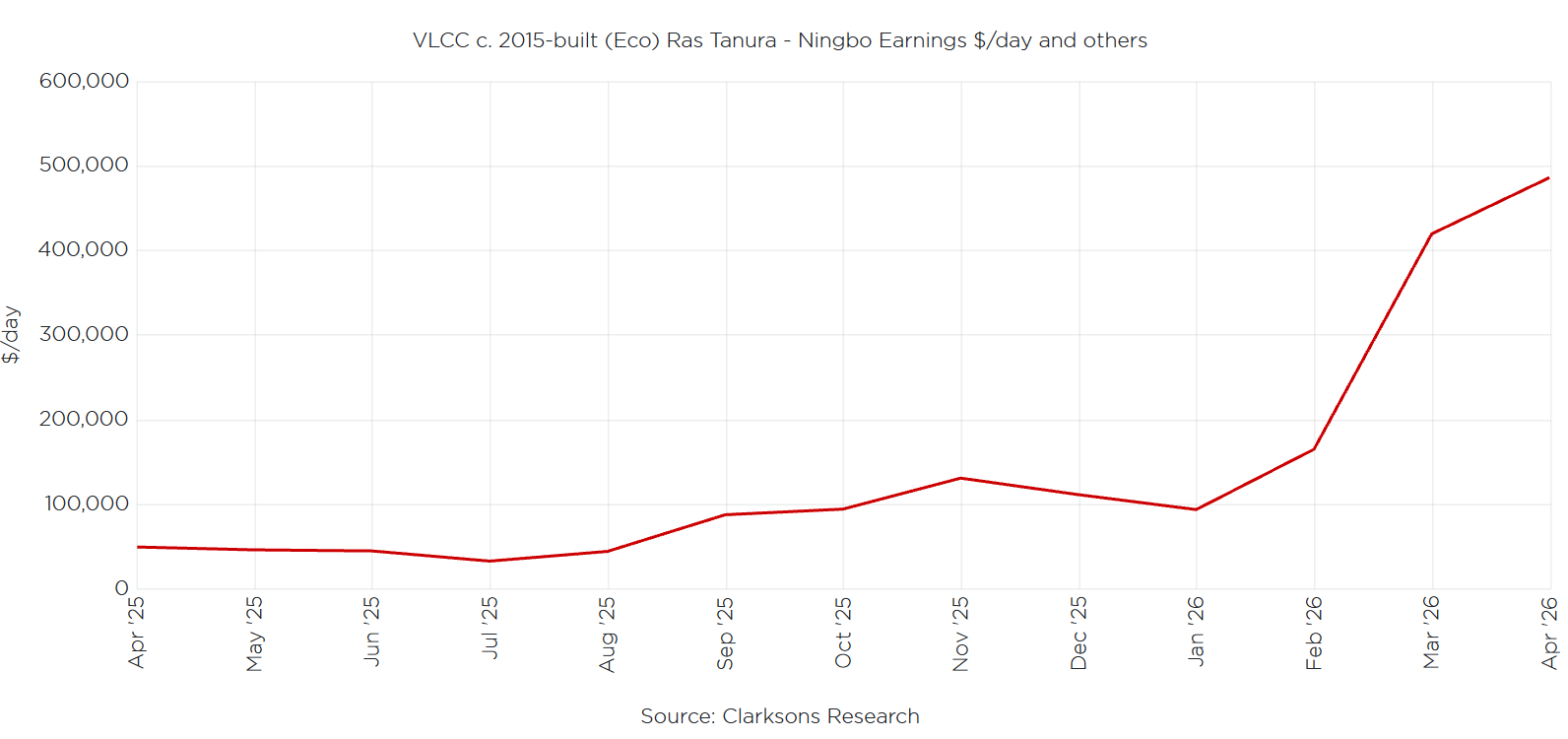
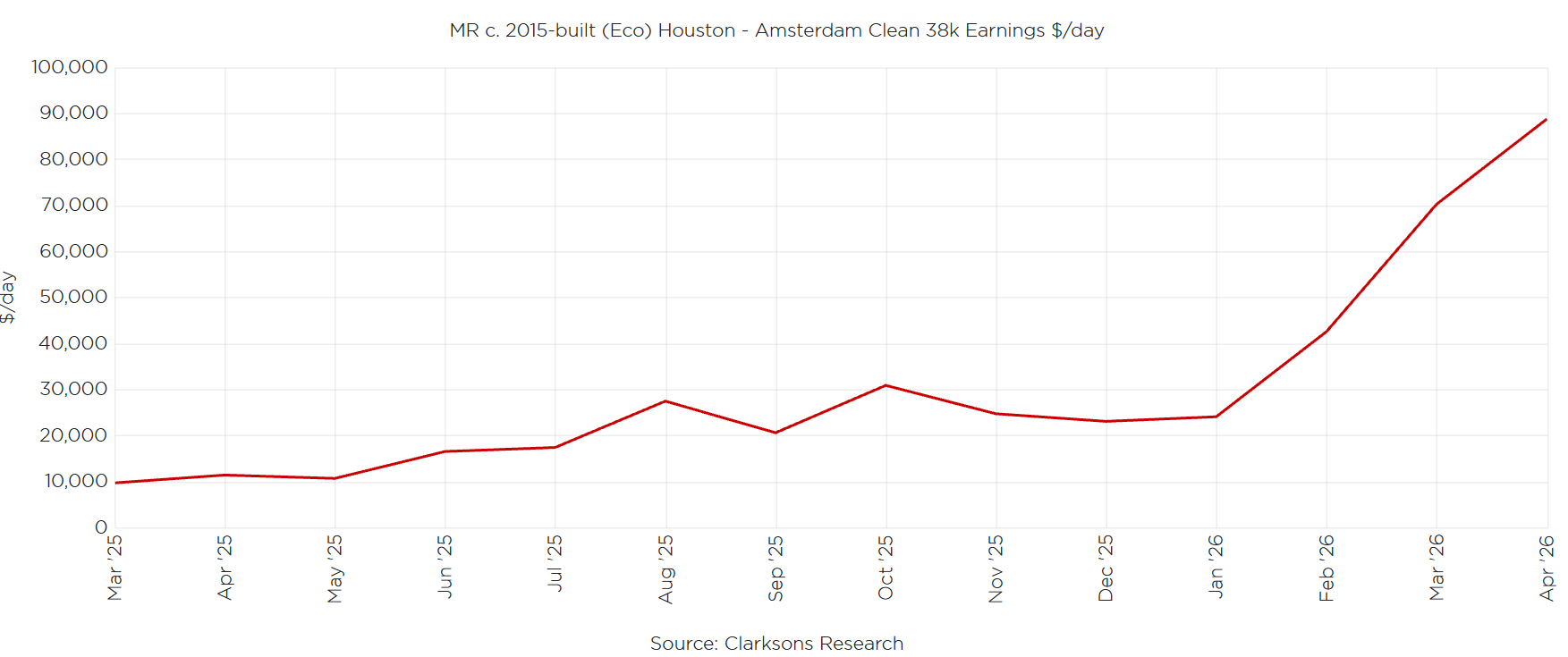
Unsurprisingly, the Iran conflict has dramatically improved the profitability of tanker shipping around the world due to the need for ships to re-route around the Persian Gulf (requiring longer voyages) and a lower vessel supply, also due to some ships being stranded in the Middle East. Shippers measure profitability in terms of Time Charter Equivalent (or TCE), which represents total freight revenue minus any voyage costs and divided by the number of voyage days. Essentially it represents the number of dollars earned per day, per vessel. At present, the TCE for a medium range (MR) tanker for refined petroleum products is running at $95,000 per day. This TCE is a 7-9x increase from just twelve months ago. Very large crude carriers (known as VLCCs) are currently fixing at a TCE of $550,000 per day, which is an 8-10x increase over the same period. See figures below depicting TCE’s for Very Large Crude Carriers (VLCC’s) and Medium Range tankers over the last twelve months.
The initial Turnstone Maritime fund is raising capital for a period of 18-24 months to lease tankers and provide shipping capacity/ship wet fuel cargos utilizing the global spot market. The fund would target the generation of consistent profits, e.g. $5,000 to $10,000 per ship per day, despite the volatility of TCE’s amidst recent geopolitical upheaval. Turnstone and Namor plan to partner with one or more large commodity traders to lock in shipping demand and effectively utilize their fleet of ships. To mitigate the impact of TCE volatility on overall returns, Turnstone and Namor would utilize the derivative markets (which allow investors to transfer risk) to hedge the daily earnings (TCE) of any given shipping lane. Shipping and commodity prices are volatile enough that they are willing to hedge up to 80% of the price exposure, forgoing 10-15% of the potential earnings to eliminate the bottom 50% of price moves.
According to Wiswell. “Our aim is to provide access to a global market typically available only to established industry participants. There is limited correlation to public markets and private investments, especially in times of broader, heightened volatility. Our objective is to provide a unique entry point into an otherwise opaque and rather inaccessible market with high return potential. People can buy publicly listed shipping equities, but our goal is to give direct exposure to the freight rates that drive tanker earnings.”
Like any investment, investing in tanker shipping comes with material risks, including the possibility that a ship gets attacked during its voyage (something that can be covered by insurance) and the inability to adequately hedge price volatility in derivative markets. Beyond this, many countries and energy companies are now looking to rely less on shipping wet fuels to limit disruption from geopolitical events, which could lessen demand for tankers over the long term.
The performance of tanker shipping as an investment strategy is yet unproven. However, in a market where the correlations between traditional and alternative investment vehicles have been increasing, exploring fundamentally different or unique asset classes can be time well spent.
My securities licenses expired long ago. This is not investment advice!